Ultra Short Throw vs. Short Throw vs. Standard Throw
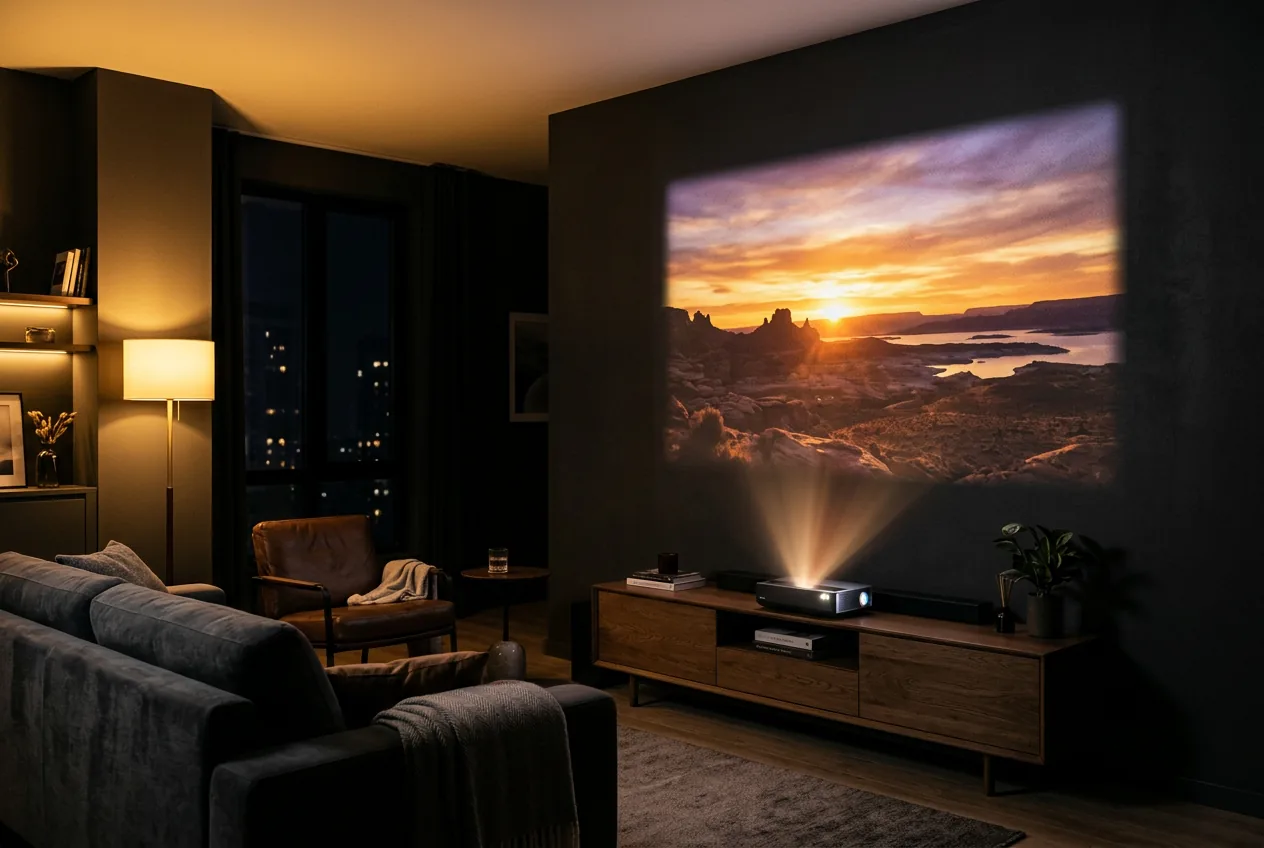
This is a room decision before it's a spec decision. Which of these three you should buy depends on where the projector can physically sit, not on which one is "better."
The short answer
All three project the same kind of image, the difference is throw ratio, distance to width. Ultra short throw (UST) sits inches from the wall on a low console or TV stand, no ceiling mount, no cable run across the room. Short throw sits a few feet back, coffee table or low shelf. Standard throw needs real distance, typically ceiling mounted or placed at the back of a mid-size to large room. Full ratio ranges and a calculator are in understanding projector throw distance.
Side by side
| Ultra short throw | Short throw | Standard throw | |
|---|---|---|---|
| Throw ratio | 0.19-0.42 | 0.38-1.0 | 1.1-2.2 |
| Placement | Low console, inches from wall | Coffee table, a few feet back | Ceiling mount or room's back wall |
| Cable routing | Simplest, everything at the console | Simple, still near seating | Often needs a run to the ceiling or back wall |
| Sensitive to ambient light on screen | More, due to steep projection angle onto standard screens | Moderate | Least, most conventional projection angle |
| Best fit | TV-replacement setups, can't or don't want a ceiling mount | Small to mid rooms, flexible furniture layout | Dedicated home theaters, larger rooms |
What our own catalog shows
Across the ultra short throw and standard/short throw 4K laser projectors this site currently tracks, UST models run more expensive on average, a reflection of the more complex short-focus optics required to project a large image from inches away without distortion. Standard and short throw models, which include options from budget-focused brands, cover a wider price range. Neither category is inherently the better deal, price per 1000 lumens (this site's ranking metric) varies more by individual model than by category. Check Ultra Short Throw and Home Theater / Standard Throw for current listings ranked that way.
Why UST costs a real tradeoff on screen material
UST's steep projection angle, light hitting the screen from just above the console rather than head-on, means a standard matte white screen scatters ambient light back at the projected image more than it would with a conventional throw angle. Many UST buyers pair the projector with an ALR (ambient light rejecting) screen designed specifically for this angle, which adds real cost beyond the projector itself, factor that in when comparing UST's sticker price against short or standard throw.
ALR screens work through microscopic optical structures embedded in the screen material, most commonly a Fresnel pattern (concentric, semicircular ridges) or a lenticular/grid pattern. Both are designed to reflect light arriving from the steep, low angle a UST projector uses straight back toward the viewer's seating area, while absorbing or scattering light arriving from other angles, like a window or ceiling fixture, away from the viewer. That angle-selective behavior is what lets a UST setup stay watchable with some room light on, something a plain matte white screen can't do nearly as well at UST's projection angle. See BenQ's explainer on ambient light rejecting screens and ProjectorCentral's deeper look at how UST-specific ALR screens are engineered for the full optical explanation. The tradeoff: ALR screens are engineered for one specific throw angle range, and generally cost more than a plain screen of the same size, both real costs worth budgeting alongside the projector itself.
How to actually decide
Start with what your room physically allows, not what looks best on a spec sheet. No ceiling mount possible, or a rented space where you can't run cable through a wall? UST is close to a requirement, not just a preference. Have a dedicated theater room with real depth and a permanent mounting option? Standard throw usually gives more model choice and often better price per lumen. Somewhere in between, a living room where a shelf or table can sit a few feet back? Short throw splits the difference.
Frequently asked questions
What is the difference between ultra short throw, short throw, and standard throw projectors?
Throw ratio, distance from screen for a given size. UST sits inches away, short throw sits a few feet back, standard throw needs real room depth or a ceiling mount.
Is ultra short throw worse quality than standard throw?
Not inherently, but it's more sensitive to screen surface and ambient light due to its steep angle, a real tradeoff, not a general downgrade.
Can a short throw projector be ceiling mounted like a standard throw one?
Yes, if the room has the depth for its ratio, short throw isn't restricted to tabletop placement, it just needs less distance than standard throw to fill the same screen size.
How does an ALR screen work with a UST projector?
Optical structures in the screen material reflect light arriving from the UST projector's steep, low angle back to viewers, while absorbing light from other angles like windows or room lighting.