Laser vs. Lamp Projectors: Why Every Projector Here Is Laser
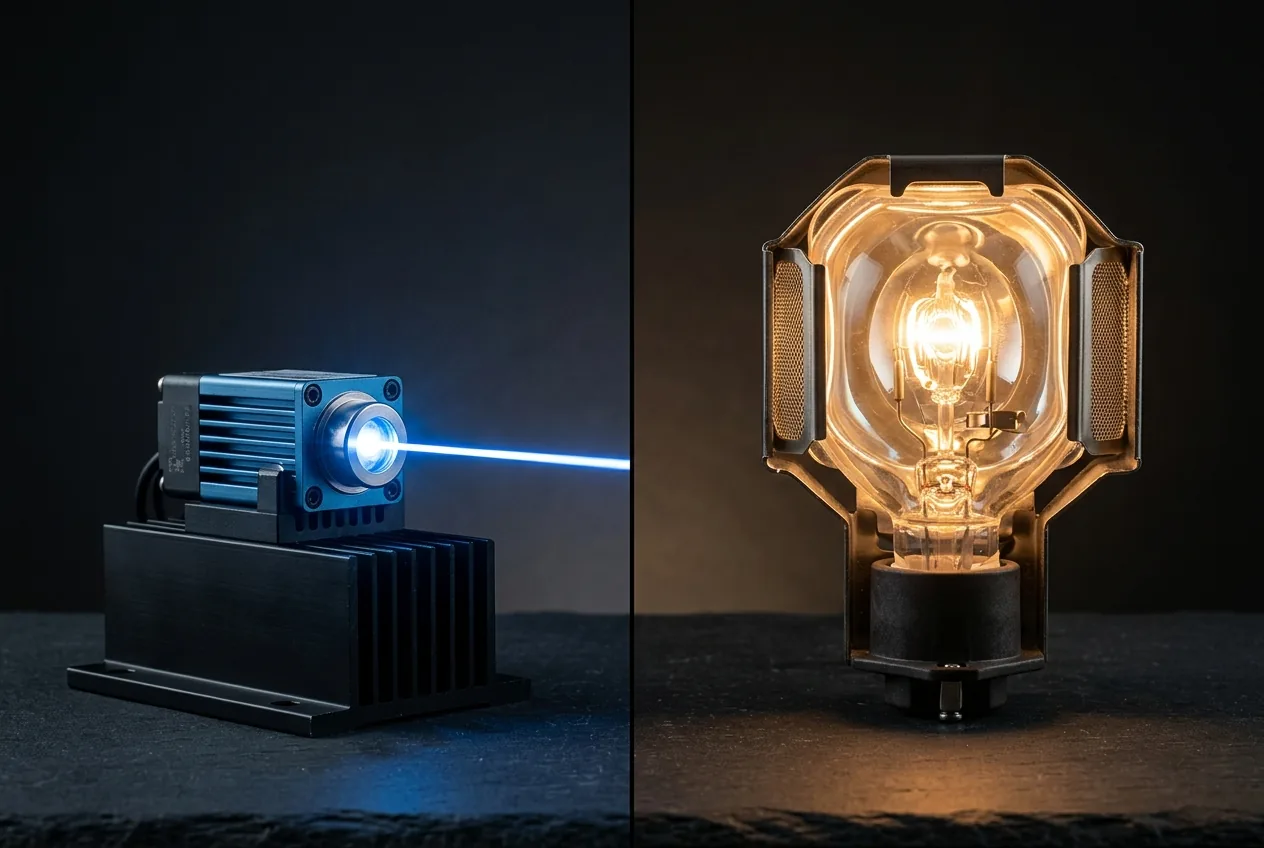
Every projector this site tracks is laser, not lamp, on purpose. Here's what that light source actually changes, and why it's worth paying more upfront for.
The short answer
A lamp projector uses a traditional bulb (usually UHP, ultra-high performance mercury vapor) that dims steadily from day one and needs replacing every 2,000-5,000 hours, at $150-$300 a bulb. A laser projector uses solid-state laser diodes rated for 20,000-30,000 hours, roughly 20 years at 3 hours a day, with no bulb to ever replace and far less brightness drop-off over that lifespan.
Why laser costs more upfront but often less overall
| Lamp | Laser | |
|---|---|---|
| Typical lifespan | 2,000-5,000 hours | 20,000-30,000 hours |
| Brightness at end of life | Drops noticeably, often 50% or less of rated output | Degrades much more gradually |
| Replacement cost | $150-$300 per bulb, repeated every 1-3 years of regular use | None under normal use |
| Startup time | 30-60 seconds to reach full brightness | Near-instant, full brightness in seconds |
| Upfront price | Lower | Higher |
Run a lamp projector regularly for a few years and the replacement-bulb cost alone can close much of the upfront price gap with laser, before accounting for the brightness laser keeps that a lamp has already lost. See Barco's own lamp-vs-laser comparison and Sony's list of reasons professional installers switched to laser for how two projector manufacturers make the same case to their own commercial customers.
Single laser vs. triple laser: not the same thing as laser vs. lamp
Among laser projectors specifically, there's a second distinction worth knowing, since both show up across this site's catalog under names like "Triple Laser" or "Tri-Color Laser." A single laser (laser phosphor) design uses one blue laser diode, part of that blue light strikes a spinning phosphor wheel to generate the other colors, similar in concept to how a lamp produces a broad spectrum, just from a more efficient, longer-lived source. A triple laser (RGB laser) design uses three separate laser diodes, one each for red, green, and blue, producing every color directly rather than converting light through a phosphor. The practical difference is color gamut: laser phosphor designs top out around the Rec.709 color space (the same range most lamp projectors and older HDTVs cover), while RGB triple laser is, according to Barco's technical comparison of the two laser architectures, the only projection technology currently capable of reproducing the full Rec.2020 gamut, a meaningfully wider range used in modern HDR content. Both are still "laser" in the lifespan and brightness-stability sense this guide is mainly about, triple laser is the additional step up in color accuracy, not a separate light-source category.
Why every listing here is laser, and confirming it took two checks, not one
Building this catalog, we found that neither a listing's title nor its technical specs alone reliably confirmed a genuine laser light source. Some real laser projectors don't say "laser" anywhere in the title, their tech specs confirm it instead. Others say "laser" in the title but the structured tech-spec field doesn't reflect it. Every product on this site is confirmed laser by checking both the title and the listing's technical specification fields, not either one in isolation, a listing only needed to pass one of the two checks to count, since real laser models turned up missing the signal in either place depending on how the seller filled out their listing.
When a lamp projector still makes sense
Lamp technology isn't obsolete. It still makes sense for occasional, light use, a home theater watched a few times a month rather than nightly, where the total hours over the projector's ownership never get close to a lamp's rated life, and the lower upfront price matters more than long-run cost. For anything closer to daily use, a media room, a gaming setup, a business that runs presentations regularly, laser's lifespan and consistent brightness generally pay for the price difference.
Frequently asked questions
Is a laser projector better than a lamp projector?
For most regular use, yes, longer lifespan, more consistent brightness, and no recurring bulb cost. Lamp remains a reasonable choice for light, occasional use where the lower upfront price matters more.
How long do laser projector light sources last?
Typically 20,000-30,000 hours, roughly 20 years at 3 hours a day, versus 2,000-5,000 hours for a lamp.
Do laser projectors need any maintenance?
Occasional dust filter cleaning on models that have one, but no bulb replacement under normal use, unlike a lamp projector.
What is the difference between single laser and triple laser projectors?
Single laser (phosphor) designs use one blue diode and a phosphor wheel for the other colors, capped around Rec.709 color gamut. Triple laser (RGB) designs use three diodes to produce red, green, and blue directly, capable of the wider Rec.2020 gamut.